
The Middle Time
In Praise of the In-Between

The year is drawing to a close, and I find myself arriving a little out of sync—mind unruly, carried by this cold that nudges us inward. I almost skipped this weekend’s publication altogether, out of sheer lack of inspiration. But when you’ve maintained a weekly newsletter for five years, something curious happens: a quiet inner readiness settles in. A small spark that stirs and whispers, “Hey… you’re not done yet.”
La Lettre Zola
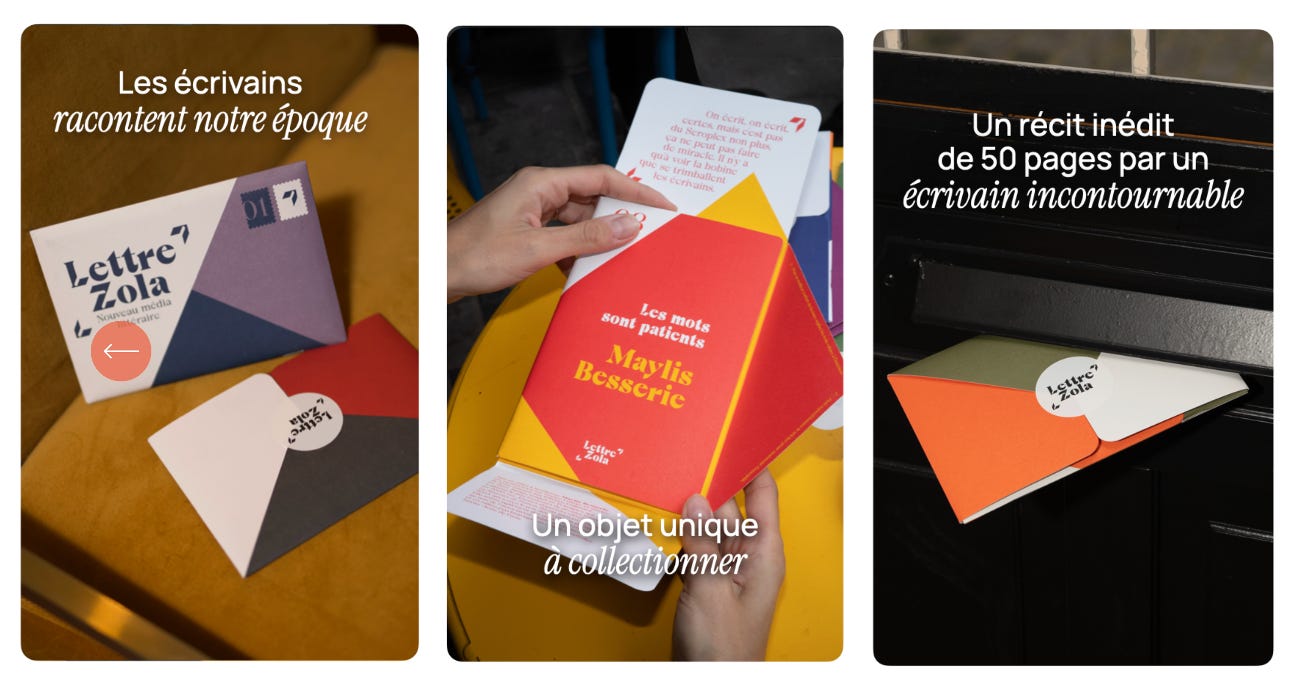
This week’s idea appeared during a conversation about La Lettre Zola, a French publishing house that has carved out its own space. Each month, they slip a fifty-page text into our mailboxes, written by contemporary authors who try to capture the feeling of our time. Simple, right? Yes, and yet so deeply necessary.
Because La Lettre Zola occupies a space that is often missing today: the in-between.
It is not the immediacy of a LinkedIn post dashed off between two meetings (instant reaction followed by instant publication) that we too often mistake for real thinking. It is not an article or a newsletter either, formats that often sit in a lukewarm space between urgency and the comfort of the familiar. And it is certainly not the long production cycle of a traditional book, which appears about six months after you hand in a manuscript (and six months is fast) while the world reshapes itself several times over.
La Lettre Zola also performs a singular gesture. The text arrives as a letter and, once folded, becomes a book. Almost a piece of editorial origami.
It may seem anecdotal. Yet it is more than a charming detail. It reintroduces a moment of availability, a physical and mental pause that prepares us to enter the text. These micro rituals, far beyond the folding itself, explain why so many readers still prefer paper to Kindles and other digital devices. As we, breathless moderns that we are, have lost precisely those small gestures that ready the mind.
There is also the element of surprise. Because everything arrives through subscription, we do not choose our reading based on a cover, a title, or an author. We receive, and we simply welcome what arrives. A discreet antidote to the digital algora that constantly chooses for us.
Giving Time Back Its Plurality
All of this brought me back to the idea of a sensitive form of digital life, or, to push the oxymoron, a kind of analog digital. I have mentioned this before, for example with this service where you send a digital letter that takes as long to arrive as a physical one. In the same spirit, we are seeing digital forms that reintroduce small pockets of latency.
This has nothing to do with the ephemeral formats of Snapchat, Instagram Stories and others, where time is used as a pretext and often tied to a toxic FOMO (fear of missing out). Besides, this is a time imposed on us. Sometimes the solution is not the endlessly repeated call to slow down (and this video is practically a parody of that injunction). The real shift often comes from reclaiming our own tempo. An italian word that refers less to time itself than to the way we tune ourselves to it. In other words, giving back time its plurality.
There’s another challenge at play, one that goes far beyond the digital-versus-physical debate. The digital world doesn’t abolish the in-between; it desynchronizes our temporalities. In real life, time never moves on its own. It is held by constraints, shaped by ritual, these structures that give texture to our gestures and depth to our thoughts. And it’s within that gap, within that shaping of time, that thought begins to warm. To think is not to produce content. To think is to produce heat.
It also makes me think of a question I sometimes have in interviews. I’ll ask a candidate for their opinion on a niche topic, knowing perfectly well they won’t have the answer. Some freeze. Others bluff their way through. And then there are those who simply say, “I don’t know, but I can try to reason it out.” That is the moment I’m looking for.
We’ve abandoned that precise moment, the interval between the question and the answer. The moment when we do not yet know, when we are still searching for the shape of an idea. It’s a fragile space we short-circuit again and again: by opening ChatGPT, by Googling our hesitation, by forming an opinion before we’ve formed meaning. I’m not demonizing the tool; I don’t believe it erases reflective in-between on its own. It’s our behavior that further drains it. And this, to me, is the true contemporary cognitive crisis: a crisis of mental digestion.
Thus, this is the time that I want to rehabilitate, a time in which my thoughts finally have the chance… to become my own.
MD
Dear Marie,
We have grown terribly efficient at expressing ourselves, and tragically incompetent at discovering what we think. Opinion now indeed precedes reflection with the confidence of youth and the wisdom of none. It is announced early, loudly, and often regrets its own haste far too late.
What I admire most in your reflection is not its defense of slowness, but its defense of uncertainty. That most unfashionable virtue. To admit that thought requires incubation is to offend an age that worships immediacy as if it were intelligence. We rush to conclusions not because they are true, but because they are available.
The tragedy is not that machines answer quickly, but that we have forgotten the pleasure of waiting long enough to surprise ourselves. A mind that never lingers never flirts with originality. It merely repeats, with great speed, what has already been said more slowly—and better—by someone else.
After all, thought is like wit: it only sparkles when it has been allowed to mature. Everything else is just noise dressed up as certainty.
Perhaps the true luxury now is not time itself, but the discipline of not rushing to fill it. After all, the mind, like conversation, is at its best when it allows itself a well-timed pause, just long enough to become irresistible.
Thanks for this thoughtful piece of wisdom.