
The AI Glow
Can maturity be borrowed like a style?


Several times over the past few weeks, I’ve come across brilliant articles, well written, with that sense of solidity that comes from a line of reasoning that unfolds cleanly. Pieces that end up haunting me, as if a small seed kept traveling through my mind. The hallmark of the best content, no?
And yet, deep down, something feels off. So I dig a little, look into the author, and notice a recurring pattern: newsletters created after 2022, after the arrival of large generative models, and often written by very young authors, few professional years behind them, little experience, and yet a calm, assured voice, as if maturity had been layered onto them like an Instagram filter.
This gap, where a young adult, thanks to a combination of tools, quick reading, and discursive modeling offered by AI, borrows a professional maturity they have not yet had time to acquire, is fascinating. Sometimes there is a different gap at play, involving people described as neurodivergent, brilliant but long prevented from speaking or creating, who suddenly find a new way to express themselves.
There is a lot of talk today about slop AI, hollow, mechanical, shallow content churned out in bulk. But we speak far less about what I would call AI glow, content that is not empty at all. It is driven by a sharp mind, an agile brain, someone intelligent who mobilizes concepts, references, and argumentative structures they have not yet had time to test or digest through lived experience, but who has enough finesse to select them, shape them, even extend them. There is direction in this content, without a doubt.
AI glow does not necessarily create impostors, but what does it create exactly? Perhaps rootless intelligences, able to manipulate the world before having had to survive it? Is this a new condition? A preview of what our cognitive trajectories might become? Is it less harmful than slop AI? Maybe we are still asking the wrong question. As another friend told me: “it took painters centuries to reach abstraction.”
I am not quite sure what to think, only that it strikes me. (Open to your thoughts in the comments section!)
Maybe, deep down, the issue is simply that we do not yet know the second and third order effects of AI. Electricity did not just replace candles, it transformed public space, work, sleep, social time. In the same way, AI is going to reconfigure our cognitive architecture. The more I dive in, the more I wonder whether LLMs are a kind of infrastructure for the noosphere, the concept coined by Teilhard de Chardin to describe the thinking layer of humanity, except that this infrastructure is no longer metaphorical, it is technical.
My personal conviction is that one of the major contributions of generative AI is not saturating us with what we already have, but helping us do things differently. Making the invisible visible. Through its computational power, it reveals patterns, signals, structures we could neither see nor hear nor conceptualize. Like a superpower capable of detecting new frequencies in almost every domain. In the life sciences, in health, with AI systems now detecting cancer five years in advance, and so on. This is, of course, a humanist intuition, quietly pushing back against the alarmist discourse around AI infrastructures and the people who control them.
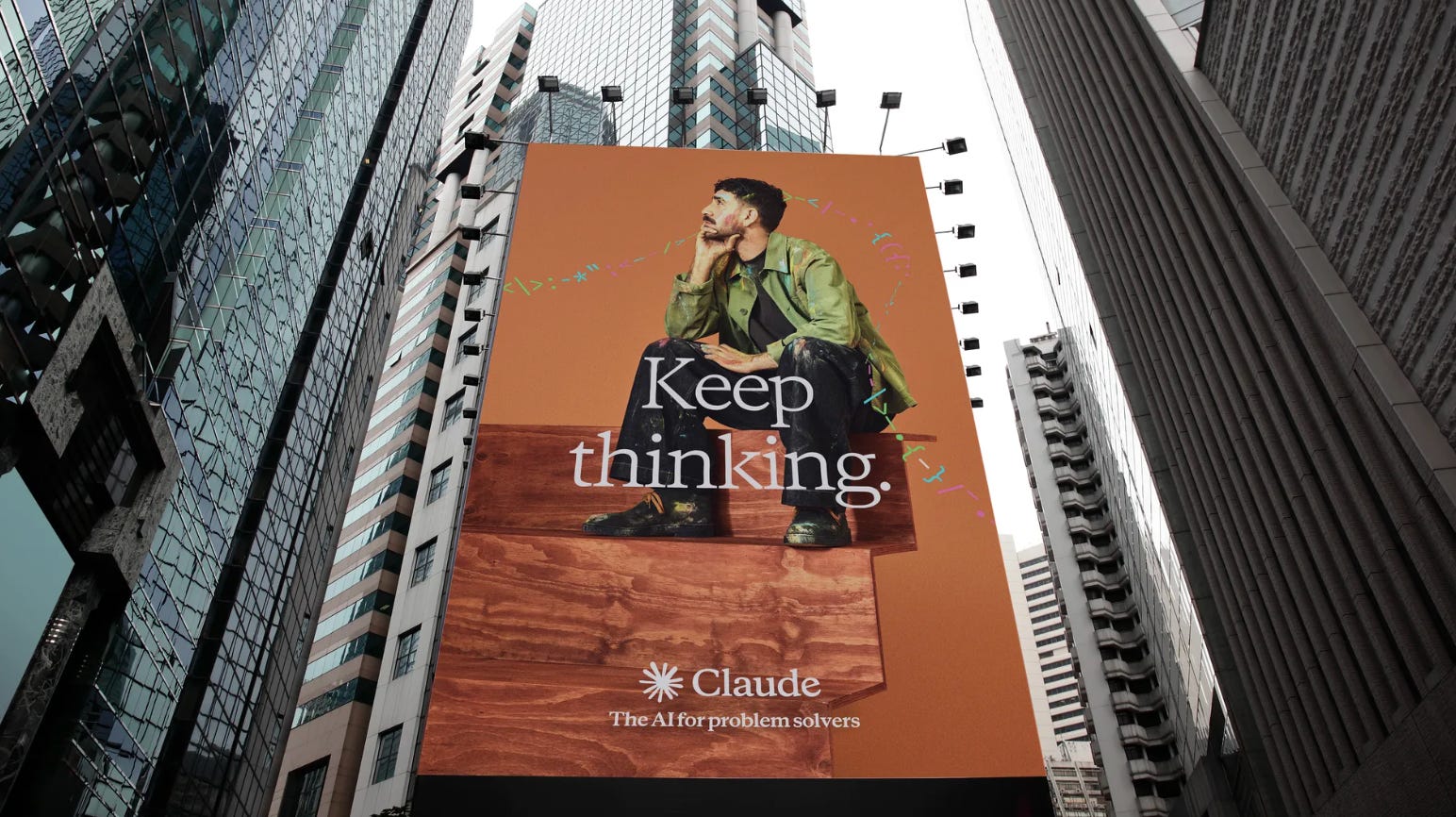
Until all of this becomes clearer, perhaps one thing remains: the need to “Keep thinking,” like stated in the latest campaign from Anthropic, creator of the LLM Claude. Think with AI, think against it, think alongside it, think without it, but think regardless. And maybe, just as importantly, keep living.
MD
I get this idea of “AI glow,” and I appreciate the nuance you bring to it. I majored in Creative Writing, then spent more than a decade teaching English, so I’ve watched how one’s voice matures through living alone. Through bruises, risk, failure, and the ultimate revision. AI can simulate that voice, but it can’t live it. Carpe diem, with a pen.
But... I don’t see that simulation as a threat. In my own work, especially through TATANKA where I collaborate with AI daily, I’ve found that the tech doesn’t replace my maturity. It tests and refines it, often in new ways I’d not alone. It pressures me to grow, to sharpen my instincts, to see the blind spots in my own thinking. I don’t allow it to agree with me but to be brutally honest. It finds and offers patterns and possibilities I might not have reached myself, but the interpretation, the meaning-making, the emotional truth, all still come from the part of me that has lived enough years to understand what the patterns actually mean in context. Information, not data.
I don’t borrow maturity from AI. I leverage it, synthetic or organic (as some believe), as contrast. A reflective surface that pushes me to develop my own voice further. As a former teacher, I am acutely aware of how it can accelerate learning, how it stretches cognitive range, sure, but the grounding still has to come from the human who has walked through something. Anything.
To me, that’s the more interesting frontier on which we stand, on its mere cusp. Not whether AI gives writers a solid base of creative potential, but how humans can use these tools to sharpen the ones they already possess. As you point out, we’re only beginning to see the second and third-order effects. Bring them, I say. I don’t fear them. I just try to keep thinking, keep living, and keep letting the collaboration push me into becoming a better writer, creator, learner, teacher, human.
Couldn't agree more. Some new Pilates gurus have this AI glow!