
Open Doors
Can efficiency erode judgment?


Earlier this week, I came across a post by Nicholas Thompson, who resurfaced an observation by Turing Award laureate Richard Hamming. The subject? A detail that seems trivial: leaving one’s door open… or closed.
We like to imagine that isolation is the ultimate armor for conquering a mountain of work today and tomorrow. Isn’t that the mantra imposed on us, this dizzying pull of “ever more”? Yet Hamming observed that, over ten years, those who wall themselves off tend to lose their sense of what truly matters. With admirable zeal, they exhaust themselves on problems that only brush the periphery of the essential. By contrast, while openness to others brings its share of interruptions, it also allows one to gather subtle signals from the pulse of the world. (not to be confused with the open-plan office, where everyone’s noise eventually drowns out each individual voice)
This anecdote echoed my participation earlier this week in the show Le Festin by Carlos Diaz, focused on AI in society and airing at the end of the month. One guest confidently advocated delegating all “low-value” tasks to focus exclusively on what “really matters.” When I asked him to define the useless, he cited email sorting. I replied that these autopilot moments are not necessarily dead ends. They can be necessary breathing spaces for the mind, pauses that prevent overload and allow us to absorb what has already been done. With the hindsight one rarely has under studio lights, I would add that one can sort emails perfectly well without AI, but that is beside the point. My remark became a thread throughout the evening. The guest amused himself with the contrast, already imagining himself devoted to noble pursuits while I lingered in the supposed emptiness of my inbox. Yet this management of messages is nothing more than the digital version of the open door. A link, imperfect but real, to the world.
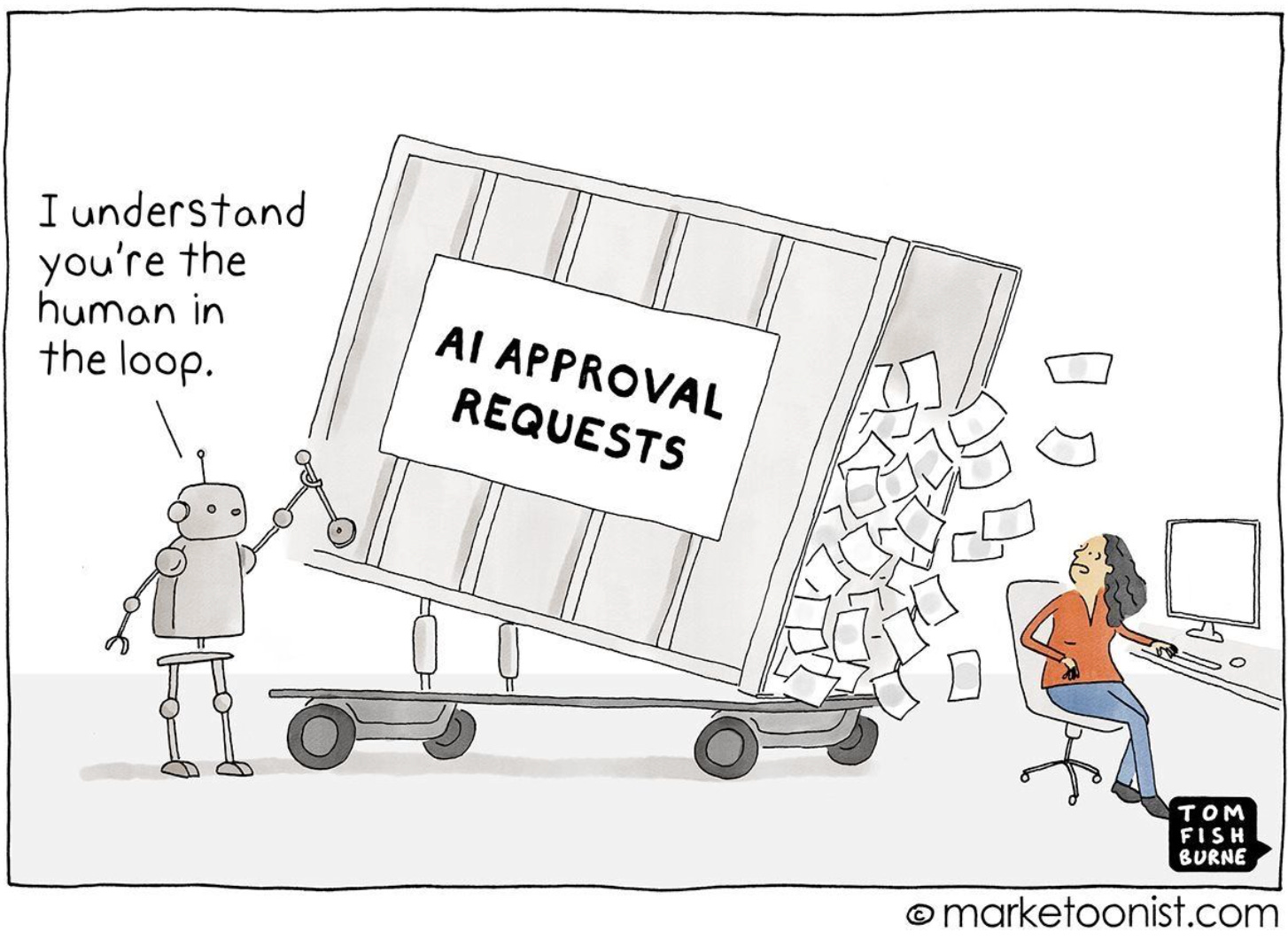
There are other side effects bound to emerge. In delegating massively to intelligent agents, we are quietly moving from creator to validator. We automate to save time, only to risk drowning in a flood of machine-generated “approval requests.” Is it truly better to become the “human in the loop,” as Tom Fishburne so aptly depicts with his container of requests pouring onto an overwhelmed human, than to sort one’s own messages? I leave the question open.
And so I, generally pro-AI, found myself playing the skeptic for the span of a dinner. A small step aside in the service of nuance, to reflect on what we lose when we gain something. I was not alone in questioning this race toward speed. To my right, Laurie Soffiati, France director of Nabla, brought welcome depth to the discussion. For her, technical progress is a means without intrinsic end. It is an autonomous force following its own logic, for what can be done will be done, unless we direct it toward a defined purpose.
Drawing on Jacques Ellul and Hannah Arendt, she reminded us that innovation can increase workload while impoverishing the meaning of action. If we allow private companies alone to determine the nature of progress, without filtering it through our democratic values, we condemn society to endure epistemic choices made by others.
For an innovation to become true social progress, we must first know what we intend to defend. Values cannot be delegated to an algorithm because they require the very thing automation most surely erodes: the depth of judgment. LLMs are virtuosos of rhetoric but novices of nuance. They ‘reframe’ problems to smooth them over just when we need architectural thinking more than ever, the kind that links cause and effect in their entirety.One might argue that a « good prompt » is enough to save the day. But that is to forget that language is a muscle. If we stop exercising it to structure our own deep thought, we end up adopting the flatness of the machine.
You will have understood that, beyond email management, my intention was to open an ontological debate. Perhaps automating this sorting is preferable, perhaps it is not. But at its core, is this not a false debate? Today’s AI still resembles the era of paddle steamers. We are mechanizing the oars while waiting for the steam engine. And yet, the age of oars has long since passed.
In this transition, where we are navigating by sight, I obviously don’t have all the answers. But I do hold one certainty: the absolute necessity of questioning our choices. It is our last safeguard against the expropriation of our judgment. Because by relentlessly stripping our days of the “non-essential” without ever questioning its purpose, we forget to ask ourselves which direction we are rowing in
MD
We humans tend to judge things as good or as bad. Sometimes both too much and too little are harmful, but there is a “just right” range.